We've worked with El Navarrico for more than 20 years. Based in San Adrian, Navarra, one of the most fertile regions in Spain, they’re a specialist processor of pulses, vegetables and fruit. A family business run by Jose Salcedo, the company produces Brindisa’s Navarrico range of jarred pulses, artichokes, asparagus and piquillo peppers.
Navarra's Perfect Growing Conditions
Local people from Navarra are known as Navarricos in Spain, hence the company's name. All their produce is grown in the area of San Adrian, Navarra, in the upper reaches of the Ebro valley. In the open fields, irrigated by the headwaters of the river Ebro, fruit trees blossom in the spring and lush leaves develop through the summer.
It is not just the irrigation that makes this such a productive region; the terrain is quite rocky, which allows for excellent drainage and the climate, with big variations between day and night time temperatures, are both ideal for the cultivation of artichokes, asparagus and peppers, the main crops that the company processes. The richness of the soil can partially be judged by the quantities of mud that stuck to our footwear when we visited!

Asparagus Season
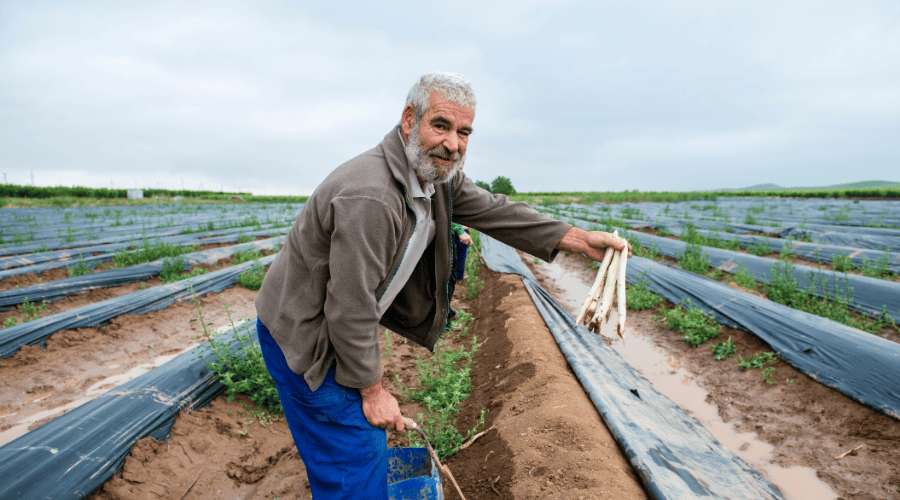
The piquillo peppers are in season during September and October and artichokes from November to mid-May but we visited in early June, and it is the asparagus we were interested in this time. These are picked between the end of April and the middle of June and we arrive at the end of the season.
- The asparagus plants are grown in raised rows (esparragueras) with the earth heaped up to about 30cm and then covered with black plastic sheeting; this is the barrier that will prevent the sun from getting to the plant and turning the white asparagus green.
- As the pickers go along the rows, they push back the sheeting and the very tips of the asparagus are, visible; these are cut with an implement that looks a bit like a curved chisel (guvia).
- The spears are then trimmed to approximately 22cm using a very low tech technique, whereby the stalks are put into a box and the bits that stick out are sawn off; it's crude, but effective!
Jose Salcedo do not own any of the land, instead they work with a few farmers and growers whose values regarding quality match theirs; these people will often grow more than one type of fruit or vegetables.
In the Factory
After being picked, the asparagus is taken to the factory, here it’s washed, peeled and trimmed to 20 cm before being briefly scalded in boiling water. It’s then allowed to cool down, is graded by thickness and put into tins in a mild brine. During an average season they will process around 15 tonnes over a six week period.
The factory has been very cleverly laid out in a space which is flexible and can be adapted to the needs of the season; the canning/bottling conveyor belts can be moved to connect with the cooker in which the beans or chickpeas have been prepared, or moved again to facilitate the packing of piquillo peppers or whatever is required. The regular workforce numbers 25 but, during busy periods (which occur when processing seasonal crops such as artichokes, asparagus and piquillo peppers) they will use double this number.

Did you know?
There is no essential difference between green and white asparagus, the colour is simply explained by the presence or absence of chlorophyll in the plant which is created by a reaction to the sunlight. White asparagus has a longer history of consumption in Europe, which explains the celebrations to mark its harvesting in countries such as Germany and Holland, as well as Spain.














 10 people
 30-40 mins